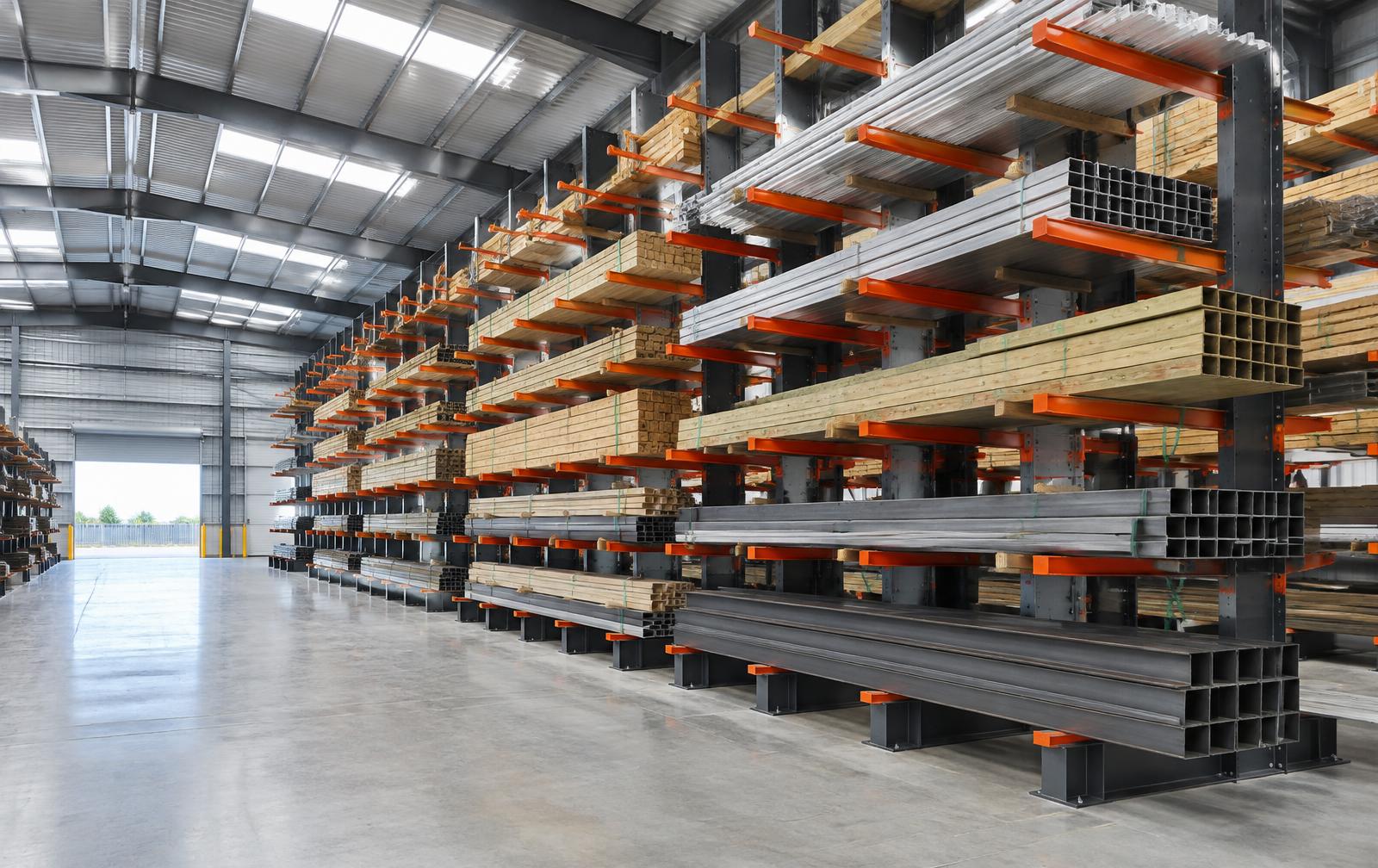
What is Cantilever Racking?
Cantilever racking is a specialist storage system designed for materials that cannot be stored on conventional pallet racking — long lengths, irregular shapes, and bulky items that overhang standard beam levels. Unlike adjustable pallet racking, cantilever systems have no front upright column, giving completely unobstructed access along the full length of every arm level. This makes cantilever racking the system of choice for timber merchants, steel stockholders, plumbers merchants, carpet and flooring distributors, furniture manufacturers, builders merchants, and automotive component suppliers storing exhaust pipes, bumpers, and body panels.
The system consists of a central vertical column (the tower), horizontal base feet for stability, and a series of cantilevered arms projecting outward from the tower at adjustable heights. Arms can be fitted on one side (single-sided) or both sides (double-sided) depending on available floor space and access requirements. Load capacities range from light-duty systems handling 200kg per arm to heavy-duty structural steel systems rated at 1,500kg per arm or more.
Cantilever Racking Applications
Cantilever racking is used across a wide range of industries where long-length or bulky materials need organised, accessible storage. Timber merchants and joinery workshops use cantilever systems to store softwood and hardwood lengths, sheet materials, and mouldings — with arm spacing adjusted to suit different lengths and grades. Steel stockholders rely on heavy-duty cantilever arms rated for coiled strip, bar stock, structural sections, and tube. Plumbers and builders merchants store copper pipe, plastic conduit, soil pipe, and ducting on purpose-designed pipe arms with end stops. Carpet and flooring distributors use wide-arm cantilever systems to store rolls upright or flat. Furniture manufacturers store flat-pack panels, worktops, and door blanks in bay-width configurations that allow forklift or sideloader access.
Types of Cantilever Racking System
Light duty cantilever racking suits hand-loaded materials in trade counter environments — timber lengths, pipe, and sheet goods up to around 200kg per arm. Medium duty systems handle mechanically loaded materials including steel bar, timber packs, and sheet metal, with arm capacities typically between 400kg and 800kg. Heavy duty structural cantilever racking is used in steel service centres, fabrication yards, and offshore logistics for structural sections, coiled strip, and heavy tube, with arm ratings from 800kg to 1,500kg and above. Outdoor cantilever racking uses hot-dip galvanised steel to withstand exposure — common in timber yards and steel stockholders with covered yard areas.
Supply and Installation
Cantilever racking systems require specialist design — arm spacing, column height, base foot sizing, and bracing configurations all depend on the materials being stored, the floor slab specification, and the mechanical handling equipment in use. Our specialist site at cantileverrackinguk.co.uk handles the full process from free site survey through structural calculation, supply, and installation. Our SEIRS-registered installation teams work across the UK, and our Somerset base gives us fast response across the South West, South Wales, and the Midlands.
Cantilever Racking FAQs
What materials can be stored on cantilever racking?+
Cantilever racking is designed for any material that is too long, too wide, or too irregularly shaped for conventional pallet racking. Common applications include structural steel sections, steel bar and tube, timber lengths and sheet materials, plastic pipe and conduit, carpet rolls, furniture panels, worktops, exhaust systems, aluminium extrusions, and flat glass. The unobstructed front face of the system allows forklifts, sideloaders, and overhead cranes to access materials at any point along the arm without obstruction.
What is the difference between single-sided and double-sided cantilever racking?+
Single-sided cantilever racking has arms projecting from one face of the column only and is typically installed against a wall to maximise floor space. Double-sided systems have arms projecting from both faces of the column and are positioned in open floor areas with access from both sides, effectively doubling the storage capacity of each tower. Double-sided systems require adequate aisle width on both sides for safe forklift or sideloader operation.
How much weight can cantilever racking hold?+
Arm load capacities vary significantly depending on the system specification. Light-duty systems typically rate at 150kg to 300kg per arm, medium-duty systems at 400kg to 800kg, and heavy-duty structural systems at 800kg to 1,500kg per arm or higher. Total bay capacity depends on the number of arm levels and the column and base foot specification. All systems must be designed by a structural engineer and load-tested to the rated capacity before use.
Do you offer outdoor cantilever racking?+
Yes — outdoor cantilever racking systems are manufactured from hot-dip galvanised steel to BS EN ISO 1461 standard, providing long-term corrosion protection in exposed environments. Outdoor systems are commonly used in timber yards, steel stockholders with covered yard areas, builders merchants with external storage bays, and plant hire depots. Base feet are designed for installation on concrete hardstanding with appropriate anchor bolt specifications for outdoor slab conditions.
How is cantilever racking installed?+
Cantilever racking installation requires a SEIRS-registered installation team working to the SEMA Code of Practice for the Design of Static Racking. The process begins with a site survey to assess floor slab thickness and loading, available headroom, aisle widths for the handling equipment in use, and the specific materials to be stored. Structural calculations are produced before installation, and the completed system is signed off with a load notice stating the rated arm and bay capacities. Visit cantileverrackinguk.co.uk to book a free survey.
How much does cantilever racking cost?+
Cantilever racking costs depend on the system specification — arm capacity rating, column height, number of arm levels, single or double-sided configuration, and whether the system is for indoor or outdoor use. Light-duty trade counter systems are significantly more cost-effective than heavy-duty structural steel systems for steel stockholders. For an accurate quotation based on your specific materials and building, visit cantileverrackinguk.co.uk or call 0800 654 6955 for a free site survey.
Let’s make space for your business.
Free survey. Expert advice. Your quotation within 24 hours.